


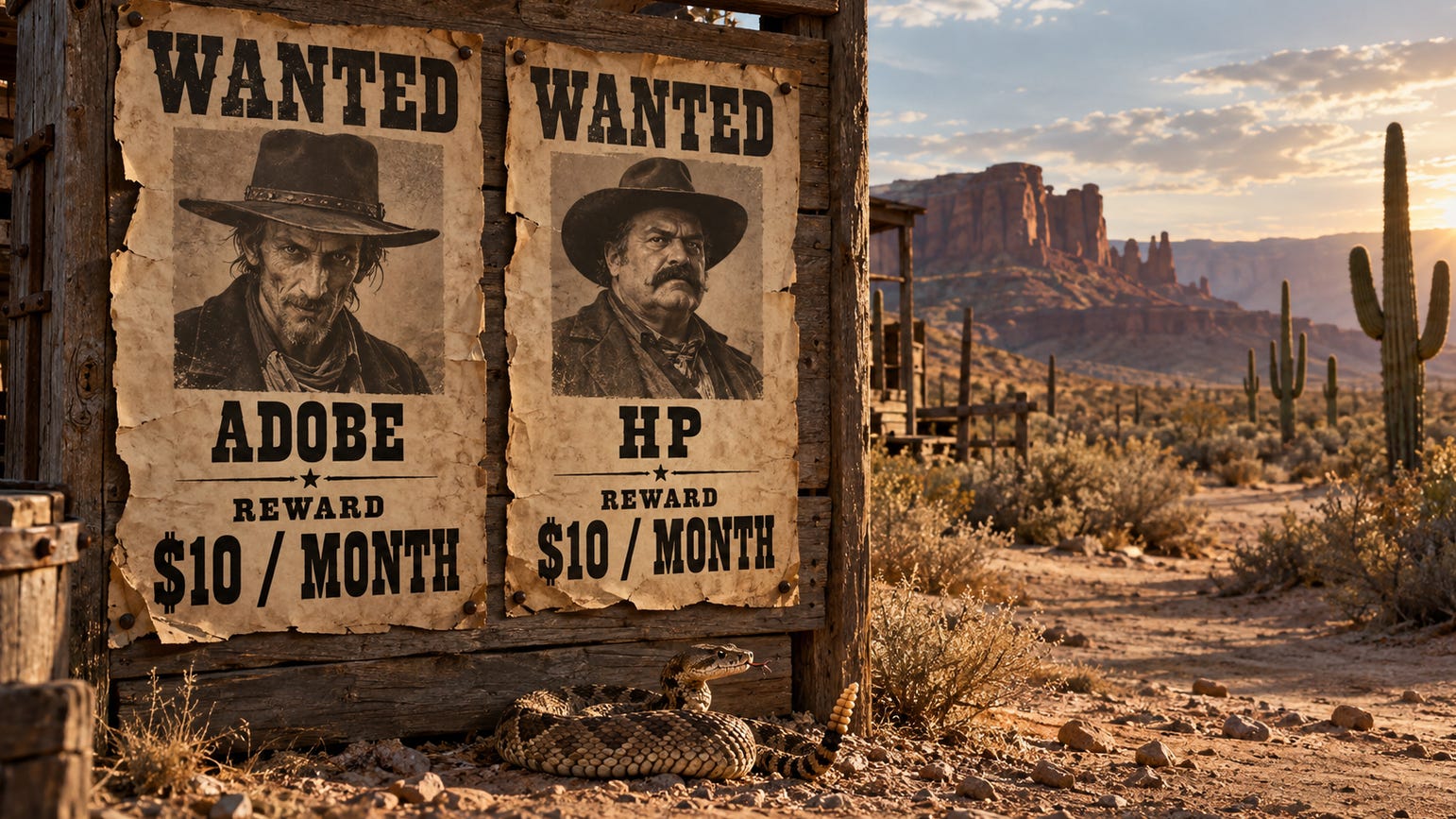
A man dies and arrives in hell. The devil hands him a laptop.
“Good news. You can still use Photoshop.”
“And the bad news?”
“Your subscription survived you.”
Once, that would have been a joke about hell. Now it sounds like a promising customer retention strategy.
Software as a Service (SaaS) arrived with the promise of making our lives easier. No installation nightmares. No expensive servers sulking in cupboards. Just log in and work. Somewhere along the way, convenience acquired a billing department, the billing department acquired ambitions, and the customer discovered that his tools had become somebody else’s property portfolio.
The question is whether we are buying a useful service or paying indefinitely for permission to carry on with our lives.
There is a difference. The invoice rarely mentions it.
1. How Software Acquired a Landlord
Software rental has a longer history than the modern cloud, but the web gave it a mass market. Salesforce, founded in 1999, helped establish the model of delivering business applications over the internet. Instead of installing and maintaining everything themselves, companies could pay a provider to do the heavy lifting. 1
Perfectly reasonable. Most businesses have better things to do than resuscitate a server at three in the morning.
Then the arrangement spread. Software increasingly became an ongoing relationship, which sounds lovely until you realise the relationship has no natural conclusion and one partner can rewrite the terms.
Adobe provided a particularly memorable milestone in 2013, announcing that new creative product innovations would go to Creative Cloud subscribers, with CS6 remaining the final major release for perpetual licence customers. Photoshop would keep evolving. Continued access to those new versions would come with a meter attached.2
Strictly speaking, buying traditional software rarely meant owning its underlying code. You bought a licence to use it. But a perpetual licence generally let you keep using that version on compatible hardware without making another payment. You could decide that the old version was good enough.
That decision had commercial consequences.
A satisfied customer who stops buying upgrades is an awkward creature. Subscription billing solves the problem by making satisfaction irrelevant to the arrival of the next invoice.
Photoshop still runs largely on your own computer, so it is not identical to a browser application hosted elsewhere. Yet its subscription model illustrates the same shift in power. The provider retains an ongoing veto over access to a tool you may already have spent years learning.
Your expertise stays. Your permission expires.
2. The Handcuffs Are Surprisingly Comfortable
To be fair, SaaS offers genuine benefits. A small company can obtain sophisticated tools without a colossal initial investment. Teams can collaborate across continents. Updates, backups and security maintenance can be handled centrally. Capacity can grow without someone buying more hardware and sacrificing a weekend to configure it.
Those are services worth paying for.
There is nothing inherently sinister about recurring payment for recurring work. Developers need salaries. Servers consume electricity. Customer support is performed by people who also have the unreasonable habit of eating.
The trouble begins when the subscription becomes a substitute for choice.
Monthly charges accumulate into a permanent toll on working life. A provider can raise prices, remove features or impose changes on which you were never consulted. An outage can strand your business. An account problem can interrupt access. Migration becomes a small archaeological expedition through proprietary formats, integrations and processes nobody has documented since Kevin left.
You can leave, technically.
You can also move house by carrying the furniture on your back. The existence of an exit tells us remarkably little about the cost of using it.
3. Your Ink Has Been Disconnected
HP’s Instant Ink programme brings this arrangement into the physical world. Under its terms, subscription cartridges are remotely disabled after cancellation takes effect. The printer itself is not permanently bricked. You can continue printing with suitable replacement cartridges.3 [3]
That distinction matters. So does the absurdity.
There can be ink sitting inside a functioning machine on your desk, yet your permission to use those particular cartridges has ended. The material exists. The mechanism works. The commercial blessing has been withdrawn.
We have taught a cartridge to recognise delinquency before teaching most printers to recognise paper.
Adobe’s June 2024 terms controversy touched a different nerve. Language concerning access to and processing of user content provoked alarm among creators. Adobe subsequently clarified that customers retained ownership of their work and that it did not train Firefly on customer content. This was not a transfer of everybody’s copyright to Adobe.4 [4]
It was, however, a useful demonstration of how uncomfortable dependence becomes when the rules are written elsewhere.
If your livelihood rests on a platform, a terms update is no longer background paperwork. It is a stranger entering your workshop with a clipboard. Perhaps the explanation is perfectly legitimate. You would still prefer that the stranger did not hold the keys.
This is where “technofeudalism” earns its place as a metaphor.
The modern digital lord does not need to own your painting. Controlling the workshop, the tools and the road to your customers can be quite sufficient. You supply the skill and labour. The platform collects for continued access to the estate.
The castle has excellent onboarding.
4. The Castle Has an Emergency Exit
Against that arrangement, open source offers something more consequential than a discount. It offers a different distribution of power.
It did not suddenly materialise because somebody became angry about Photoshop. The free software movement predates modern SaaS. Richard Stallman announced the GNU project in 1983, while the “open source” label emerged in 1998. Their emphases differ, but both traditions challenge the assumption that users must remain powerless before whoever supplies their software.5 [5]
Their renewed appeal is a natural response to subscription dependence. They had been discussing the door locks long before the rest of us noticed we were tenants.
With free and open source software, the licence gives people rights to inspect, modify and redistribute the code under its conditions. For software you can run yourself, that opens practical possibilities. You can retain a working version. Someone else can maintain it. A community can develop a fork if the original project takes a direction its users reject.
Most users will never read the source code.
Most tenants will never become locksmiths either. That does not make possession of a key an obscure technical indulgence.
The ability of other people to inspect and continue a project matters even to those who simply want to edit a photograph. It creates alternatives to the original supplier’s decisions. When a company says “take it or leave it”, leaving can become something more substantial than a disgruntled post on social media.
Established projects already demonstrate the possibilities. GIMP provides image editing, Inkscape handles vector graphics, and Blender offers a broad 3D creation environment. These are distinct tools with their own capabilities and limitations, rather than interchangeable replicas of every commercial competitor.6 [6]
They also puncture the notion that sophisticated software must arrive trailing an eternal payment mandate.
PhotoCraft belongs in this discussion too. Its public repository describes an independent Photoshop reimplementation written in Rust, with layers, masks, adjustment tools and PSD support. The project is distributed under MIT and Apache licences. Those are open source licences, not a declaration that Adobe’s entire suite has entered the public domain. 7[7]
Interesting? Absolutely.
Proof that Photoshop has been annihilated, pixel for pixel, with zero lag? A repository is not enough to establish that. Professional reliability has to survive difficult files, obscure workflows and the client who needs everything by yesterday.
We can welcome an alternative without appointing its README emperor.
5. Freedom Still Needs Technical Support
Nor should we pretend that openness eliminates every inconvenience. Compatibility can be imperfect. Documentation may be patchy. An essential feature might be missing. Self-hosting can hand maintenance duties straight back to the user, accompanied by the gentle sound of a weekend disappearing.
Open source also describes licensing, not sainthood. A project can have poor governance. A hosted service built from open code can still make migration painful. Real independence depends on usable exports, accessible formats, sustainable maintenance and the practical ability to run the software elsewhere.
Freedom requires infrastructure. Occasionally, it requires reading the manual.
And it requires funding. If we abandon expensive subscriptions only to demand that exhausted volunteers maintain our professional tools for nothing, we have achieved the moral sophistication of a discount sweatshop.
Pay maintainers. Buy support. Fund features. Contribute documentation. The objective is an exchange in which payment rewards useful work and users retain meaningful choices.
6. The Landlord Can Keep the Invoice
Artificial intelligence may add an especially enjoyable wrinkle.
Tools that help companies write software more cheaply can also help smaller teams build alternatives. Lower development costs do not belong exclusively to incumbents. The same shovel can dig a defensive moat or a tunnel beneath it.
But generated code still needs testing, security review, maintenance and people who understand what it does. AI does not turn an ambitious prototype into a dependable creative suite by sprinkling silicon confetti over it.
The opportunity is real. The obituary for SaaS is premature.
Plenty of users will continue to pay for hosting, collaboration, support and convenience. That is fine. A service should survive because people find it useful enough to renew, even when leaving is practical.
What deserves to die is the presumption that having captured a customer’s workflow entitles a company to collect tribute indefinitely.
So test the alternatives. Keep your exports. Learn a second tool before the first becomes indispensable. Support the people building software that respects your ability to walk away. Departure need not be theatrical to be effective.
A cancelled payment makes remarkably little noise. Finance departments hear it beautifully.
The next time a company tells you that you own your work, ask whether you can still open, edit and use it after you stop paying them. The answer will tell you how much that ownership is worth. Buy the services that earn their keep. Fund the tools that leave you free. And if the landlord insists your creativity belongs on a meter, take your files, take your money, and leave him with the one thing he actually created. The fucking invoice.